Pandora Just Solved Retail's Hardest Problem
Here's the thing about selling jewelry: you're not really selling metal and stones.
Pandora's CTO David Walmsley put it perfectly: "We don't sell pots and pans. Half of what you buy is the product, and half is the experience in the store."
That experience, the conversation about who the gift is for, what the occasion means, what memories you want the piece to carry, is what makes someone pay premium prices for something they could technically buy anywhere. It's emotional selling, and it's always been impossible to scale.
Until now.
The Two-Agent Strategy
Pandora just revealed they've deployed two AI agents with very different jobs.
Clara handles customer service. Launched in February, she now resolves 60% of inquiries without human escalation, up from 40% with their previous system. Net Promoter Scores jumped 10% after her deployment. For a brand that does 40% of annual revenue in Q4, this kind of efficiency isn't nice to have. It's survival.
But Clara isn't the interesting one.
Gemma is the interesting one.
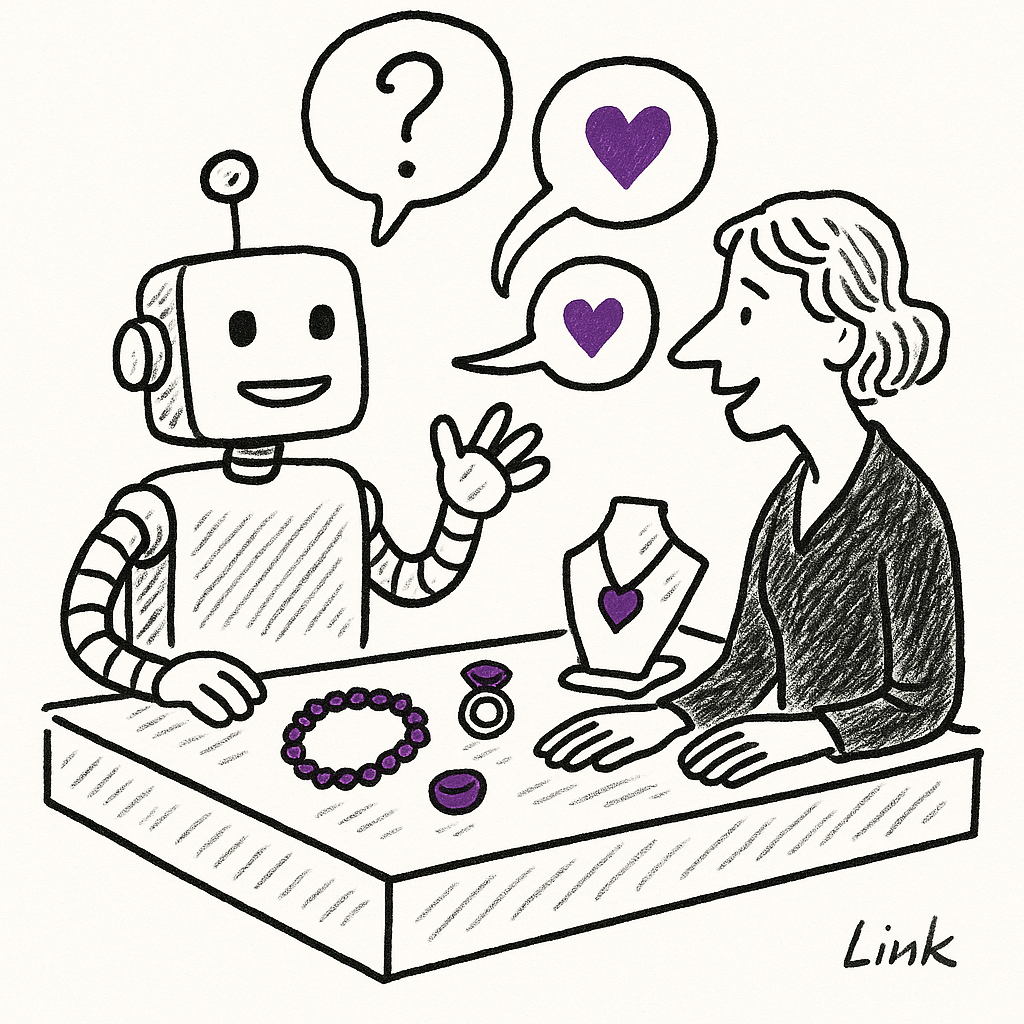
Gemma is a sales agent, currently in quiet testing with 20% of Australian site traffic. Her job isn't to answer questions. Her job is to sell, specifically to replicate the emotional selling experience that happens in physical stores.
She asks questions a good sales associate would ask: Who is this gift for? What's the occasion? What do you want them to feel when they open it? What memories should this piece represent?
Then she narrows recommendations based on those answers.
Why This Matters for Every Operator
Let me connect the dots for anyone running a gym, a hotel, a restaurant, or any business where the experience is the product.
The scaling problem has always been human. Your best associate, your most charismatic trainer, your most attentive server. They can only be in one place at a time. They get tired. They have bad days. They quit. And when you're doing 40% of revenue in a few peak weeks, you can't hire and train fast enough to capture all of it.
AI agents don't solve for average performance. They solve for consistency at scale. Clara doesn't have a bad day. Gemma asks the same thoughtful questions at 2am on Christmas Eve that she asks at noon on a Tuesday.
The data capture is almost more valuable than the sales. Pandora's agents collect "customer intent and sentiment that clickstream data cannot provide." When someone tells Gemma that they're buying a gift for a daughter graduating from medical school, that's information no amount of browsing behavior could reveal. That memory stays in the system. Next time that customer comes back, the AI knows their story.
The Neuroscience Angle
Here's what makes emotional selling work at the brain level, and why AI might actually be good at it:
Research on aesthetic preferences shows our brains respond to certain patterns almost automatically. A 2007 fMRI study found that proportions following the Golden Ratio activated the anterior insula, a region linked to emotional responses, without conscious deliberation. The reaction was "largely automatic and non-conscious."
Emotional selling works similarly. When a sales associate asks "What do you want her to feel when she opens this?" they're activating circuits that have nothing to do with rational product comparison. They're triggering the emotional brain.
The question is whether AI can activate those same circuits. Pandora's betting yes.
And here's the counterintuitive part: AI might actually be better at this than humans in some ways. An AI doesn't feel awkward asking personal questions. It doesn't rush because the store is busy. It doesn't unconsciously judge the customer's budget. It just... asks. Consistently. Every time.
What Operators Should Take From This
1. Think in agents, not chatbots. The difference between a chatbot and an agent is intent. Chatbots answer questions. Agents have goals. Clara's goal is resolution without escalation. Gemma's goal is emotional connection leading to sale. If you're building AI into your customer experience, start with the goal.
2. Your best employee is now a training dataset. What makes your top performer great? Document it. Those questions they ask, that sequence of conversation, those moments where they read the customer. That's what you're trying to encode. Pandora didn't build Gemma from scratch. They studied what their best associates do in stores.
3. Peak season is the test case. Pandora's doing this for Q4 because that's when the stakes are highest and the human bottleneck hurts most. What's your peak season? That's where AI agents pay back fastest.
4. Capture the intent data. Every emotional selling conversation is intelligence about your customer that you'd never get from clickstream analytics. Build systems that remember. "Customer memory across digital channels" isn't a feature. It's the strategic endgame.
The Bigger Picture
We're at an inflection point in retail and hospitality. For decades, the tradeoff was simple: you could have personalized, emotionally resonant service or you could have scale. Pick one.
Pandora is betting that's a false choice now.
If they're right, if AI agents can genuinely replicate the emotional selling that happens in the best physical retail experiences, then the competitive landscape shifts dramatically. The operators who figure this out first won't just be more efficient. They'll be able to offer premium experiences to everyone, not just the customers lucky enough to get the best associate on the floor.
That's not incremental improvement. That's a different game.
Hass Dhia is Chief Strategy Officer at Smart Technology Investments, where he helps operators apply neuroscience and AI to grow their businesses. He holds an MS in Biomedical Sciences from Wayne State University School of Medicine, with thesis research in neuroscience.